Showing posts with label sculpture. Show all posts

Tuesday, October 16, 2012

Alex Paik at Gallery Joe

Alex Paik: Prelude and Fugue

Installation view of paper wall sculptures by Alex Paik
Installation view of Alex Paik at Gallery Joe,
From Two Coats of Paint
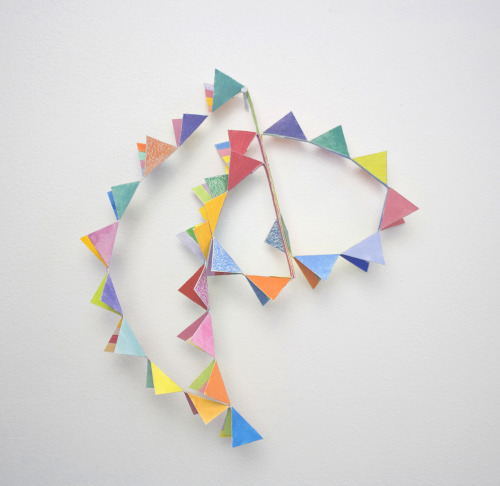
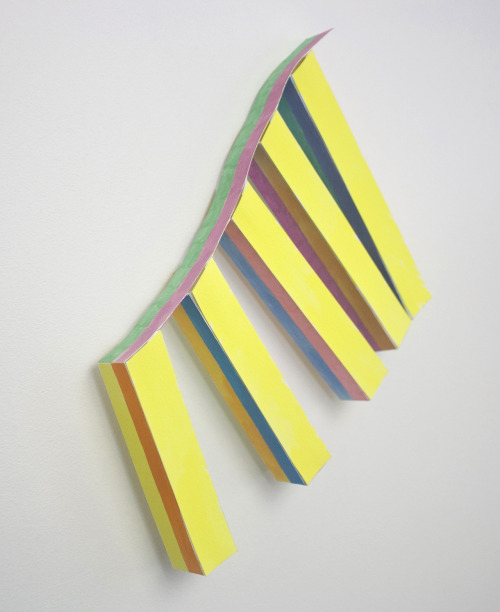
Alex Paik's suite of works made with cut paper, gouache, and colored pencil, Prelude and Fugue, is currently on display at Gallery Joe.  Paik is one of the founders of the art space in Philadelphia Tiger Strikes Asteroid.  This is his first solo show at Gallery Joe and is entitled Recapitulation Bop.  It will be on display until November 10th.
Alex Paik, 2012, Prelude and Fugue (Airy)
Alex Paik, 2012, Prelude and Fugue (Bars)
According to Sharon Butler at Two Coats of Paint, Paik is also opening a new branch of Tiger Strikes Asteroid in Bushwick in November.

Sunday, September 23, 2012

Wendy White: Pix Vää

Wendy White at Leo Koenig

Wendy White Painting
Wendy White, 11 Oliver,  Acrylic on canvas PVC and vinyl over metal frame, 2012
The past few years have marked themselves as a major turning point in the career of Wendy White. Pix Vää is White's third solo show of 2012.  She is showing paintings from her "Fotobild" and "PVC" paintings.  Her Fotobild paintings consist of images printed from her cellphone and painted over attached to a section of illegible text.  Although seemingly non-objective paintings, White ties them to specific locations: 11 Oliver refers to a building in NYC.  The painting's size allows it to engulf the viewer, and the marks represent traces of human activity (probably from around the building).  

Wendy White Painting
Wendy White, 15 Monroe, Acrylic on Canvas, PVC, 2012
Read more in the article On Top of the Rubble: Recent Work by Wendy White by John Yau.


Vince Hannemann: Cathedral of Junk

Austin's Cathedral of Junk

Picture of Cathedral of Junk
Photo by Blake Gordon of Wall Street Journal
Picture of knuckle tattoos reading: JUNK KING
thisiscolossal.com
Vince Hannemann's fingers read: JUNK KING, but his ongoing project "Cathedral of Junk" in Austin, TX is part of a much larger than autobiographical narrative: "Writing is the destruction of every voice, of every point of origin," writies Roland Barthes in Death of the Author, claiming that the origin and creator of a text, or in this case cathedral remains secondary to the work itself.  This indelible backyard art project which started in 1988 in Austin has already made its mark and left impressions on thousands of visitors, and vice versa: the "junk" that comprises the cathedral is primarily composed of stuff brought from the outside world by its congregation.

freefuninaustin.com
Although 10,000+ visitors come to see his backyard attraction each year Hannemann's personal favorite visitors seem to be children, which is no surprise considering that he clearly emphasizes imaginative thinking and creativity:
[when asked] What made you want to do this?' Like it had some sort of profound meaning. I just did it because I liked it. And when I stop liking it I'll take it down...I just did it because it was kinda cool, It's my clubhouse. It's fun. Kids, when they come through, they know what it is.

Watch this short film by Evan Burns about the Junk Cathedral

The Junk King from Evan Burns on Vimeo.

Wednesday, September 5, 2012

Artist Overview: Kaz Oshiro


Kaz Oshiro's Still Lifes

The emergence of Kaz Oshiro's stretched canvas works represents a paradigm shift in the world of still-life painting.  Like Robert Ryman before him, Oshiro's work focuses on the real experience of painting.  Unlike Ryman however, the real experience of painting begins with the construction of the canvas.  The problem is not worked out on the surface of the canvas, but in the three dimensional realm.  The piece below, Untitled Still Life, is exemplary of this approach.  The work is what it is, similar to the approach taken by Isa Genzken in relation to the still-life.
A painting of Kaz Oshiro's
Source: Contempory Art Daily
"I thought that by making an object out of a canvas I’d be able to achieve what I want to do, which is practice making things physically. But at the same time, I wouldn’t have to explain much: it’s a still life sitting on the floor. It’s a painting." -Kaz Oshiro, Kaz Oshiro's "Painting Problem"

Simulacram

Source: Yvon Lambert
The majority Oshiro's work can be seen as simulacra of everyday objects.  His paintings remain humble; his goal is not to transform the found object into an art object.  Inversely, Oshiro takes the elevated status of Pollock's canvas and quietly places it back on the ground, so to speak.  He uses traditional objects from the realm of painting (stretchers, canvas, and paint) and transforms them into what reads at first glance as an everyday object.  After closer inspection though, the viewer realizes that it the object is a hyperrealistic three-dimensional representation of that object. 

an installation by Kaz Oshiro
Source:  http://artsceneseen.tumblr.com
The image that is painted on each two dimensional surface is exactly that: a duplication of the surface being represented (which could stand alone as an abstract painting). It is only in the greater context that the illusion is created: Oshiro's works are "real illusions."  If each canvas was placed alone on a wall all that would remain would be a weak attempt at capturing the sublime.  Gestalt: the whole is greater than the sum of its parts.
Source: Galerie Perrotin